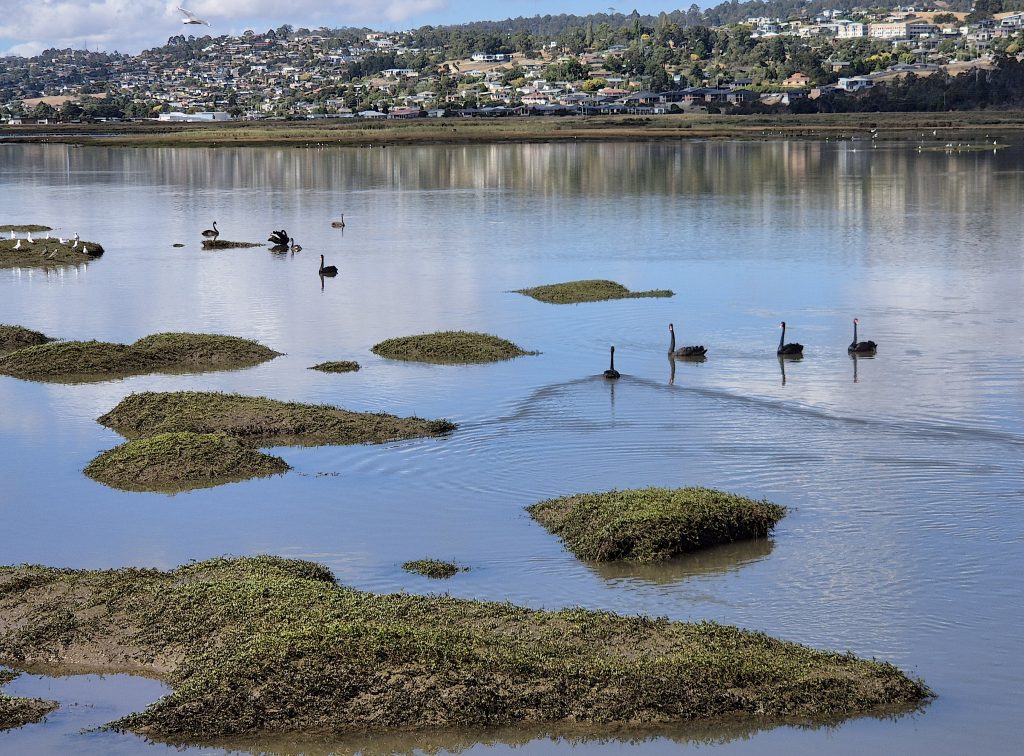
On 8 March 2025, 14 club members and guests visited Tamar Island Wetlands in the Tamar Conservation Area to view resident and visiting birds with expert bird watcher Geoff Shannon. The 60 hectares of wetlands is readily accessible by a boardwalk that starts at the interpretation centre and takes visitors through the tall grasses to Tamar Island, crossing the river at several points on footbridges. It is a beautiful setting on the banks of the Tamar River
Tamar Island wetlands (RC)
The birdlife is simply abundant, both in the number of birds and the number of species. During this visit, we saw 32 bird species, approximately half the number recognised as being in the area. These ranged in size from small birds such as the superb blue fairy-wren (Malurus cyaneus) and the silvereye (Zosterops lateralis), to much larger birds such as the black swan (Cygnus atratus) and the white-breasted sea-eagle (Haliaeetus leucogaster).
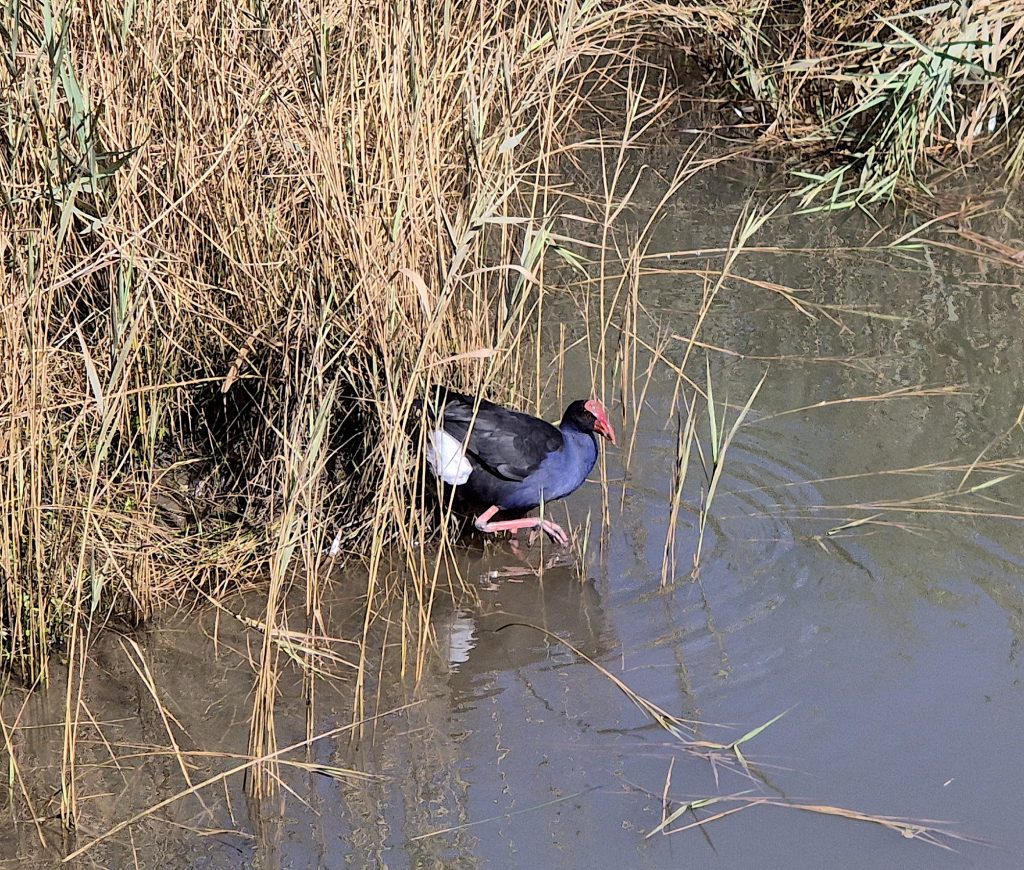
There were several species of duck, other water fowl and cormorants, all well-suited to the wetlands environment. One of the noisier birds was the purple swamphen, with its loud, penetrating call quickly getting the attention of the field naturalists. While the colouring of many birds helps them to hide amongst the mud and rushes, the purple swamphen’s colouring ensures it can be easily seen; as if its noisy call and flicking tail were not enough.
Purple Swamphen, Tamar Islands Wetlands (RC)
Considered a rare visitor to Tasmania, a royal spoonbill (Platalea regia) was seen during the visit to the wetlands. Perhaps its distribution is changing, as they have been recorded at the Tamar Island Wetlands and Queechy Lake in Launceston since 2008, and in recent years one has been seen in Bridport.
The wetlands are also home to various frogs, reptiles, mammals, insects and plants. The nationally vulnerable green and gold frog (Litoria raniformis) can be found here, although it was not seen during this visit.
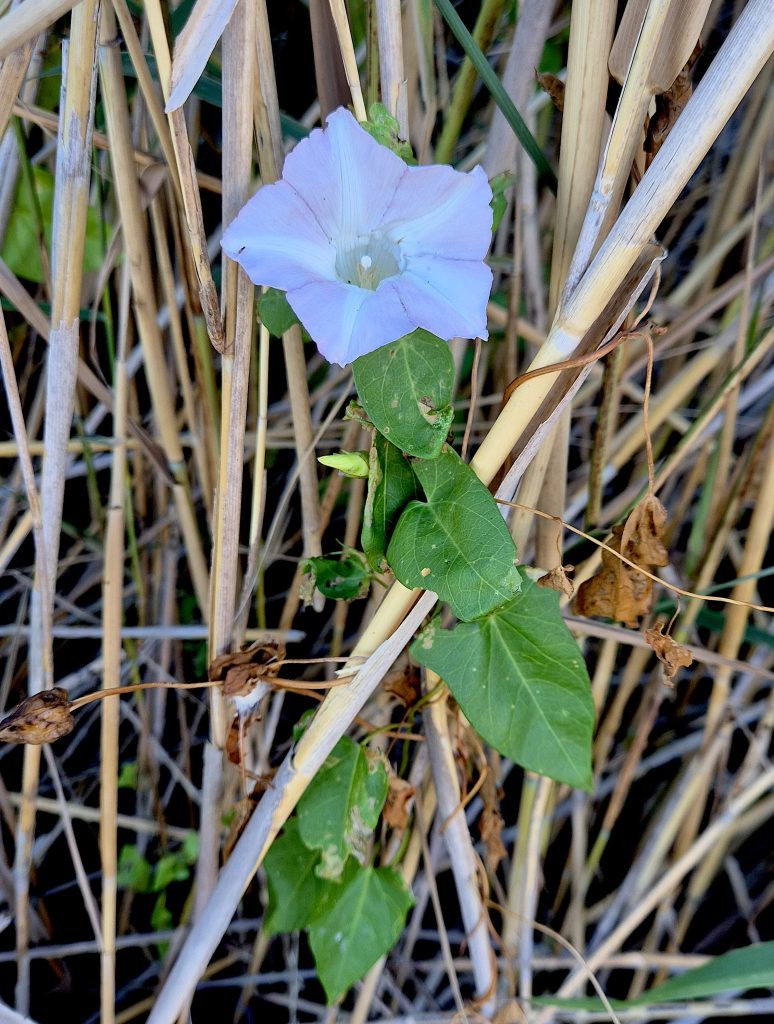
The predominant vegetation of the wetlands is the common rush or reed (Phragmites australis). The boardwalk weaves through head-high swathes of rushes, interspersed with several stands of swamp paperbark (Melaleuca ericifolia) along the way. The great bindweed (Calystegia sepium) (Image 3), a riparian species that is widespread throughout temperate Australia, rare overall in Tasmania but locally abundant in this part of the Tamar River, was seen climbing up the rushes in several locations beside the boardwalk.
Calystegia sepium, Tamar Island Wetlands (RC)
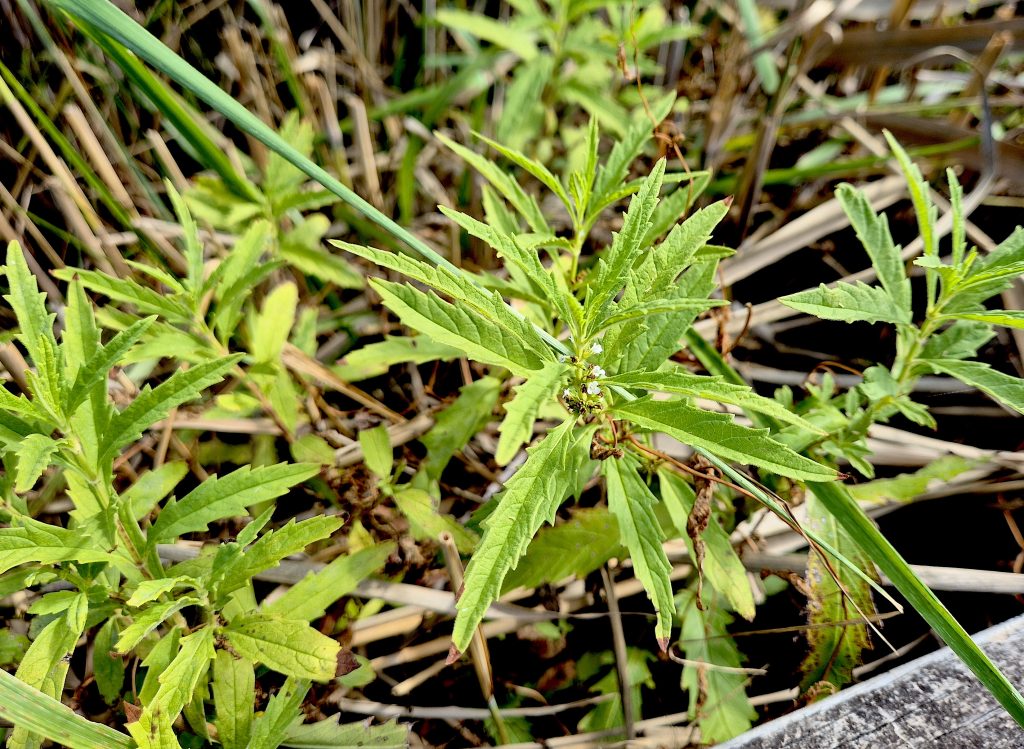
Also growing alongside the boardwalk is Australian gypsywort (Lycopus australis) (Image 4), a perennial herb. Listed as endangered, it is protected in this reserve. It is also found in the Cameron Regional Reserve, an area familiar to many of our club members.
Lycopus australis, Tamar Island Wetlands (RC)
On Tamar Island, where we ate lunch, there is evidence of its former life as a farm. European trees, such as hawthorns (Crataegus sp.) and blackthorns (Prunus spinosa) were covered in berries, while a few old pieces of farm equipment remained, including an old plough embedded in a tree trunk that had grown around it over the decades.
On our return walk, the tide was well out and wading birds such as the white-faced heron (Ardea novaehollandiae) were seen feeding on an apparently plentiful supply of small fish in the shallows. Crested terns (Sterna bergii) were seen diving into deeper water channels to catch their feed of fish. Holes in the mud indicated the homes of various crustaceans, including small crabs that lingered in the entrances to their burrows. The now revealed mud flats were very much alive with the activity of birds, fish and crustaceans.
Below is a full list of the birds that were observed during our visit .
Ross Coad
Birds observed (sighted and/or heard):
Cormorant, Great – Phalacrocorax carbo Cormorant, Little Black – Phalacrocorax sulcirostris Cormorant, Little Pied – Phalacrocorax melanoleucos Dotterel, Black-fronted – Charadrius melanops Duck, Pacific Black – Anas superciliosa Duck, Wood – Chenonetta jubata Egret, Great – Ardea alba Egret, Intermediate – Ardea intermedia Fairy-wren, Superb Blue – Malurus cyaneus Fantail, Grey – Rhipidura fuliginosa Grassbird, Little – Megalurus gramineus Gull, Pacific – Larus pacificus Gull, Silver – Larus novaehollandiae Heron, White-faced – Ardea novaehollandiae Hobby, Australian (Little Falcon) – Falco longipennis Lapwing, Masked – Vanellus miles Magpie, Australian – Gymnorhina tibicen Native-hen, Tasmanian – Gallinula mortierii Pelican, Australian – Pelecanus conspicillatus Raven, Forest – Corvus tasmanicus Rosella, Green – Platycercus caledonicus Sea-eagle, White-breasted – Haliaeetus leucogaster Shelduck, Australian – Tadorna tadornoides Silvereye – Zosterops lateralis Spoonbill, Royal – Platalea regia Starling, Common – Sturnus vulgaris Swallow, Welcome – Hirundo neoxena Swamphen, Purple – Porphyrio porphyrio Swan, Black – Cygnus atratus Teal, Chestnut – Anas castanea Teal, Grey – Anas gracilis Tern, Crested – Sterna bergii