On 12 September 2026, members of the North-eastern Tasmanian Field Naturalists Club Inc. walked along a section of the North East Rail Trail from Tulendeena Station to Kamona Station, then along Kamona Station road to Goanna Road. The distance was approximately 7 km, almost entirely downhill. The meeting point was at the intersection of Goanna Road and Tasman Highway, with carpooling to Billycock Hill across the road from Tulendeena Station.
Club members enjoyed ideal walking weather, sunny but not hot, mostly dappled shade, only the slightest breeze. At both Tulendeena Station and Kamona Station there are information boards providing interesting facts about the location, history and function of each station and the railway in general. Along the trail members spotted various remnants of the rail infrastructure, including dog spikes, sleeper plates, sleepers and a ceramic insulator. The hardiness of the workers who constructed the railway and the difficult conditions they must have endured was a topic of interest along the way. Click here for Jeff Jennings’ video of the construction of the railway.
Click on photos for a grand view
-
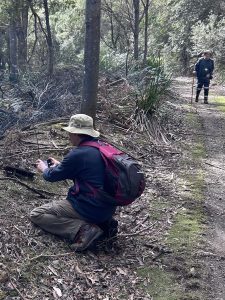
- Field nat and sleeper plate (PR)
-
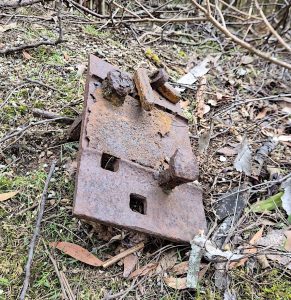
- Sleeper plate and dog spikes (RC) jpg.
However, the natural environment that has reclaimed land alongside the railway was the main focus. In a few sections, this was a thin veneer with plantation pines lurking behind, in some places the destructive ugliness of harvested plantation was unavoidable. Fortunately, most of the rail trail was bordered by native vegetation, providing many opportunities to observe flora, fauna and geology of interest to members.
-
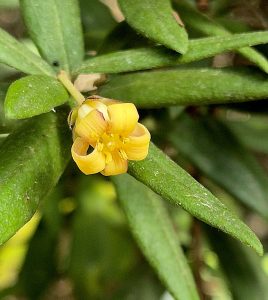
- Pittosporum bicolor (RC)
-
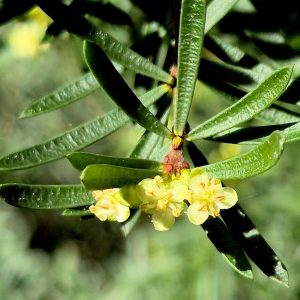
- Micrantheum hexandrum (RC)
-
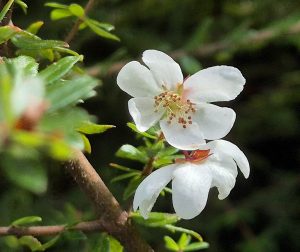
- Bauera rubioides (RC)
-
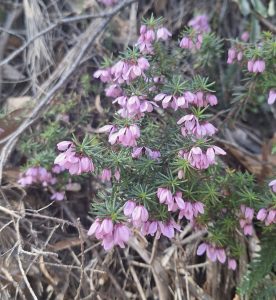
- Tetratheca sp.(CB)
Where the railway had been blasted through granite outcrops and boulders, the contrast between the beautiful grain of freshly (geologically speaking) exposed granite and the rough-textured exposed quartz grains of weathered granite was observed (thanks Ian for drawing attention to this).
Members with ears finely tuned in to bird songs and calls were well rewarded, as most of the birds were heard, not seen. Anyone with a particular interest in ferns was also well rewarded. Gentle light from the rail corridor filters into the vegetation on each side in this often damp and cool environment, supporting a good range of ferns. Many native plant species were seen alongside the rail trail, including orchids. Lists of birds, ferns and a selection of other plants are provided at the end of this report.
-
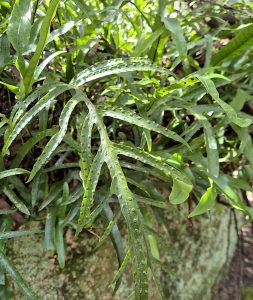
- Microsorum pustulatum (RC)
-
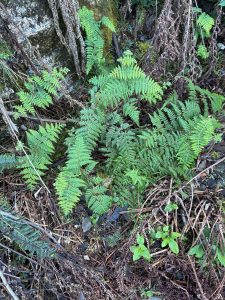
- Ruddy Ground fern (Hypolepis rugosula (DS)
Kamona Station was an ideal place to stop for lunch – the timing was right and the flat, slightly elevated area beside the trail, including a shelter with table, provided plenty of space for the group. After lunch, the walk along Kamona Station Road was a different experience to walking along the rail trail, but nevertheless interesting and pleasant, although not as soft underfoot.
-
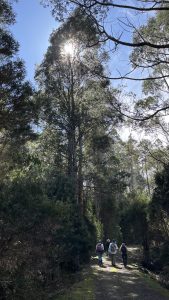
- Field Nats on the Rail Trail (LR)
-
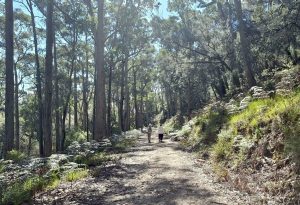
- Kamona Station Road (CB)
-
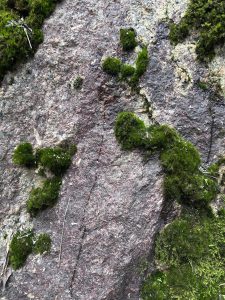
- Granite and bleeding moss (PR)
A walk from Kamona Station to Tonganah is under consideration, although it would be about double the length of the walk just completed and may include about 2 km of uphill walking.
Thanks to Anne and Pam for their lists of birds:
Grey Shrike-thrush (Jo Witty) (Colluricincla harmonica),
Brown Thornbill (Acanthiza pusilla),
Forest Raven (Corvus tasmanicus),
Fan-tailed Cuckoo (Cacomantis flabelliformis),
Olive Whistler (Pachycephala olivacea),
Yellow-tailed Black Cockatoo (Zanda funerea),
Grey Fantail (Rhipidura albiscapa),
Yellow Wattlebird (Anthochaera paradoxa),
Striated Pardalote (Pardalotus striatus),
Spotted Pardalote (Pardalotus punctatus),
Golden Whistler (Pachycephala pectoralis),
Eastern Spinebill (Acanthorhynchus tenuirostris),
Crescent Honeyeater (Phylidonyris pyrrhopterus),
Kookaburra (Dacelo novaeguineae),
Black Currawong (Strepera fuliginosa),
Superb Fairy Wren (Malurus cyaneus).
Thanks to Debbie for recording the following ferns:
Man fern (Dicksonia antarctica),
Mother Shield fern (Polystichum proliferum),
Fishbone fern (Blechnum nudum),
Hard Water fern (Blechnum wattsii),
Scrambling Coral fern (Gleichenia microphylla),
Pouched Coral fern (Gleichenia dicarpa),
Batwing fern (Histiopteris incisa),
Ruddy Ground fern (Hypolepis rugosula),
Bracken (Pteridium esculentum),
Common Ground fern/ False bracken (Calochlaena dubia),
Necklace fern (Asplenium flabellifolium),
Kangaroo fern (Microsorum pustulatum).
-
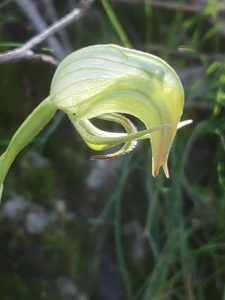
- Pterostylis nutans (AW)
-
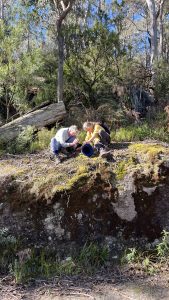
- Keen eyes spotted Mayfly orchid above the road (Acianthus caudatus) (LR)
-
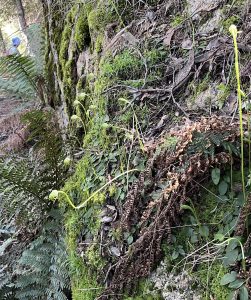
- Pterostylis nutans and photo bomber (LR)
Orchids and a selection of other plant species (thanks Pam and Lou):
Nodding Greenhood (Pterostylis nutans),
Maroonhood (Pterostylis pedunculata),
Mayfly (Acianthus caudatus),
Cheesewood (Pittosporum bicolor),
Box Micrantheum (Micrantheum hexandrum).
Wiry Bauera (Bauera rubioides),
Forest Raspwort (Gonocarpus teucrioides), leaves rough to the touch
Broom Spurge (Ampereaa xiphoclada), interesting as it appears to be leafless on theflowering stems.
Ross Coad