Winifred Curtis Reserve
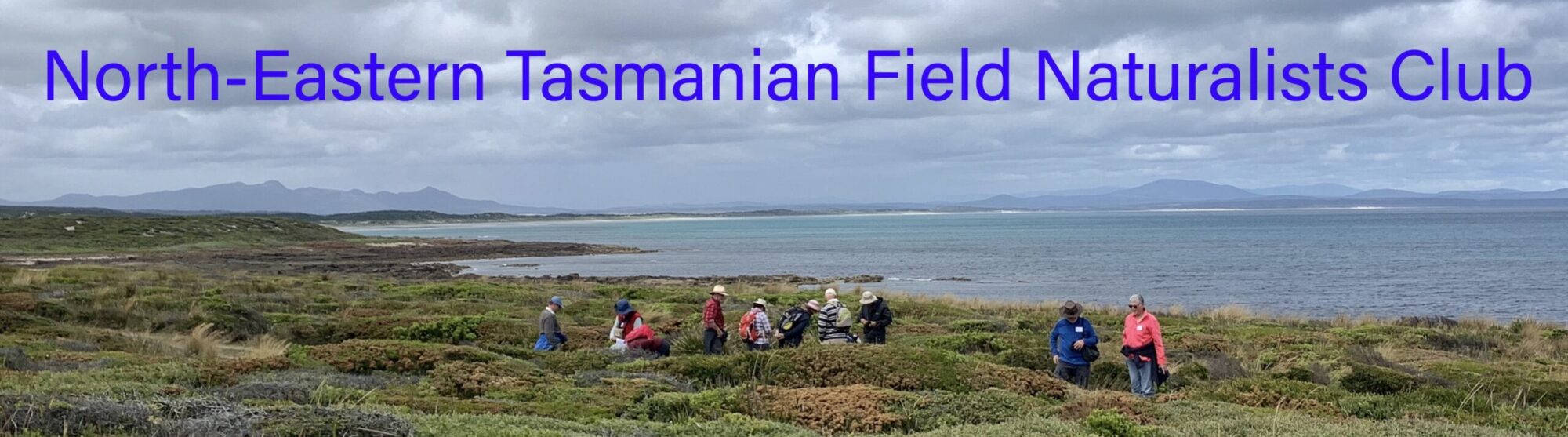
Seventeen Field Natters turned up on Sat 13th September at Scamander to explore The Winifred Curtis Scamander Reserve. First we visited the garden and nursery of Paul Frater, Chairman of Trustees of the Reserve. Paul told us something of the history of the Reserve named in honour of the late Dr Winifred Curtis, Tasmania’s most esteemed botanist. Paul’s garden is an intriguing mix of exotics, mainland natives and local flora and his joy in showing us around his land was infectious. Some members availed themselves of plants from his nursery after the excursion.
We tore ourselves away from his enthusiastic company to begin our walk in the shelter of the Reserve which covers 80 hectares with 7 kilometres of easy walking on well trimmed tracks. Maintenance is carried out by a team of volunteers. First stop was to admire a healthy patch of the quite rare Acacia ulicifolia (Juniper wattle). This is a prostrate plant which we had seen in a more upright form on Paul’s land. There are many wattles in the reserve but Acacia terminalis ( Sunshine) and A. suaveolens (Sweet) had mostly finished flowering. Acacia verticillata (Prickly moses) and A.genistifolia (Spreading) were about to begin. Epacris impressa (Common heath) and Leucopogon collinus (White beard heath) dominated the thick scrub along the Old Coach Road. We left this sandy road and followed a track up to the highest point of the Reserve where the memorial table and seats in honour of John White, an early member of NEFN, are slowly eroding away. From here there is a wonderful panoramic view, taking in North and South Sister, Mt Elephant and south to Falmouth.
-
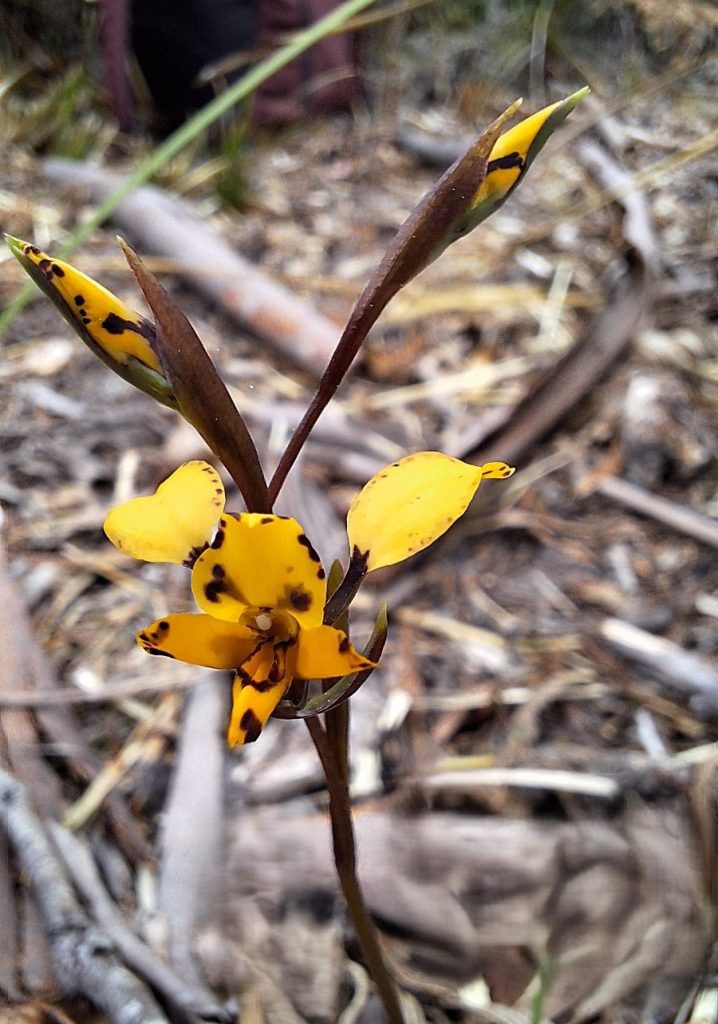
- Diuris pardina? (CB)
-
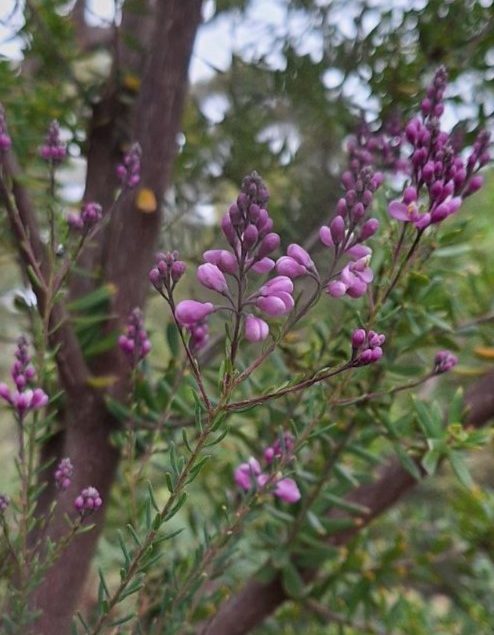
- Comesperma retusum (CB)
Hungry by now, we headed down to the Ford at the end of the Old Coach Road where the horse-drawn coaches used to cross the shallow part of Hendersons Lagoon on their way down the East Coast. There we enjoyed lunch together and were able to observe some waterbirds like the pied cormorant, the large black cormorant, the black swan and the white faced heron. Rejuvenated, most of us decided to walk out to the beach across the board-walks which cross the Melaleuca swamps, dry now after a prolonged spell of low rainfall. No whales, dolphins or rays were spotted but one member enjoyed a paddle in the sea.
Then it was back along yet another path serenaded mostly by the Grey Shrike Thrush and Yellow throated Honeyeater. It was pleasing to spot the pretty Tetratheca pilosa (Black-eyed Susan) and Comesperma retusum (Purple Milkwort) adding a splash of contrasting colour to the yellow of the wattle. Persoonia juniperina, known as the Prickly Geebung in Tasmania, is such a lovely bright green shrub with its delicate yellow tubular flowers. The Grass Trees or Xanthorrhoea australis are a feature of the Reserve and although a few had succumbed to Phytophthora root rot, most were flourishing.
This Reserve is one of the last remaining relatively pristine patches of native vegetation in this section of the Upper East Coast thanks to the efforts of a few volunteers. Tax Deductible donations can be made to support their efforts and perhaps we could consider making a Club donation next year. We certainly enjoyed our day there.
Birds seen or heard at Winifred Curtis 13/9/2025
Golden Whistler
Grey Shrike Thrush
Superb Blue Wren
White Faced Heron
Grey Fantail
Little WattleBird
Striated Pardalote
Crescent Honeyeater
Green Rosella
FanTailed Cuckoo
Yellow Throated Honeyeater
Welcome Swallow
Brown Thornbill
New Holland Honeyeater
Yellow Wattle Bird
Black Swan
Large Black Cormorant
Pied Cormorant
Pelican
Eastern Spinebill
Forest Raven Silver Gull.
Pam Bretz